Building a regional conversation on potentially polluting wrecks
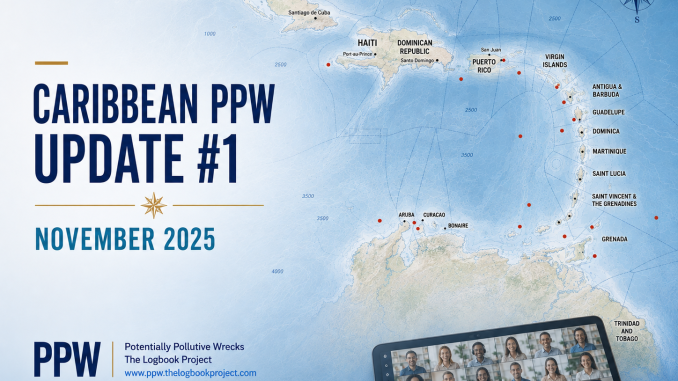
In November 2025, The Log Book Project hosted the first Caribbean PPW Update, bringing together researchers, environmental specialists, policy advisers and regional organisations with a shared interest in understanding and managing potentially polluting wrecks (PPWs) in the Caribbean.
The meeting marked the beginning of a quarterly coordination forum intended to share developments, exchange knowledge and strengthen collaboration across historical research, oil spill modelling, environmental policy and underwater investigation.
While participants represented different disciplines and organisations, discussions reflected a common objective: improving the evidence base needed to better understand legacy pollution risks from WWII shipwrecks in the Caribbean.
Highlights from the meeting
Oil spill modelling progresses
Dr Polly Hill and Jørgen Skancke (SINTEF) presented ongoing work using the OSCAR oil spill model to simulate potential releases from deep-water WWII wrecks. Discussion focused on improving the presentation of complex modelling results through clearer visualisations suitable for policy makers and non-technical audiences, while continuing to refine Caribbean-specific modelling and explore opportunities to incorporate satellite observations.
Historic research continues on Andrea Brøvig
The Log Book Project provided an update on its Historic Desk-Based research into the Norwegian tanker Andrea Brøvig. Current work continues to reconcile Allied reports, German U-boat records and survivor accounts to better understand the vessel’s final movements, cargo and probable sinking location. Participants also noted ongoing work to compare historical evidence with seabed data in support of future wreck identification.
International policy interest grows
Updates from COP18 in Cartagena highlighted increasing international attention towards legacy wreck pollution and ongoing discussions within UNEP and the International Maritime Organization (IMO). Participants discussed how robust historical evidence, oil spill modelling and wreck classification will be important foundations for any future regional or international policy initiatives.
Regional engagement
The OECS Commission shared perspectives on the practical challenges facing Small Island Developing States, emphasising the importance of translating technical research into realistic and actionable information that can support regional decision making. The discussion reinforced the need for scientific evidence that can also inform policy and resilience planning.
Deep-water investigation capability
Inkfish provided an overview of deep-ocean survey capabilities, including advanced submersibles and imaging technologies that may support future investigations of selected high-priority wreck sites where additional seabed evidence would materially improve understanding.
Looking ahead
The Caribbean PPW Update will continue as a quarterly forum bringing together organisations working across historical research, environmental science, government, industry and marine technology.
As the Caribbean PPW Programme develops, these meetings provide an opportunity to exchange progress, identify areas of collaboration and strengthen the evidence base supporting future research and decision-making.
Future meeting summaries will be published here as part of our commitment to transparency and knowledge sharing.
Be the first to comment