How we moved from remembrance to applied research, and why Potentially Polluting Wrecks became a natural and necessary focus of the work.
The Log Book Project began as a work of remembrance. In 2016, we set out to honour all veterans and witnesses of the Second World War, from every side of the conflict. The unused pages of the pilot logbook of Saint Lucian RAF pilot Cyril Devaux became the vessel for this mission, carrying their signatures and stories across generations. What started as a tribute soon became a bridge, with over 270 individuals contributing their memories.
Along that journey, certain encounters added a new layer to our work. The first was close to home.
Lady Nelson ca 1932
Torpedoed in Castries harbor 10 March, 1942.

The sinking of the Lady Nelson in Castries Harbour in March 1942 marked the arrival of war in Saint Lucia with tragic force. For many, it symbolises the region’s frontline role in the Battle of the Caribbean.
Delving into the Lady Nelson’s story and engaging with first-hand witnesses, we naturally felt compelled to understand more of the U-boat war waged in Caribbean waters. Why did this region — usually thought of as far from the European conflict — become such a maritime battlefield?
Part of the answer emerged through conversations with author Mike Mair, whose father served aboard the US Navy tanker USS Mississinewa (AO-59). In 1944, Mississinewa fuelled in Aruba before transiting the Panama Canal en route to the Pacific. Having departed Aruba, she reportedly had to outrun a submarine — a reminder of how exposed those sea lanes were.
In 2003, divers removed 1.8 million gallons of oil from Mississinewa’s leaking hull in Micronesia. Connecting those facts — her departure from Aruba under threat, and the scale of oil still recoverable decades later — brought a sobering realisation into focus: had she been sunk in Caribbean waters, she would have become one of the region’s largest Potentially Polluting Wrecks.

USS Mississinewa (AO-59)
In 2003, divers removed 1.8 million gallons of oil from her leaking hull in Micronesia — a stark reminder that wartime wrecks can still threaten communities and ecosystems decades later.
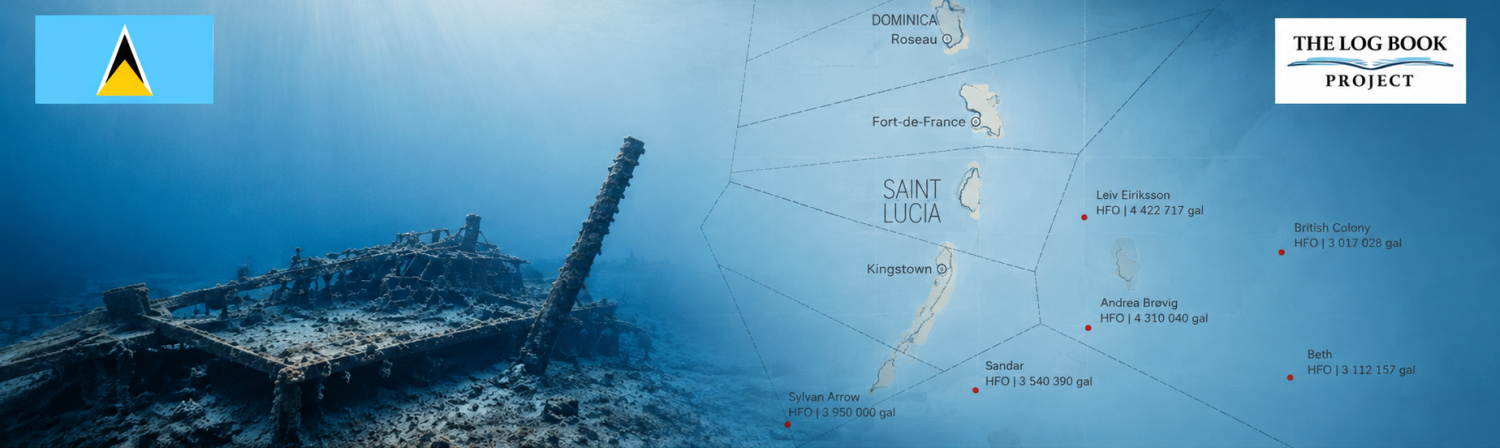
That understanding prompted us to look more closely at the wartime record. What we found altered our perception of the region’s role. More than 40 oil tankers were sunk in Caribbean waters, carrying an estimated 97 million gallons of petroleum products — a legacy that still rests on the seabed today.
These personal connections — from Castries to Ulithi Lagoon — revealed a larger truth: remembrance and responsibility are intertwined. What began as a tribute to those who served has evolved into a mission to shine light on the legacy of wartime shipwrecks.