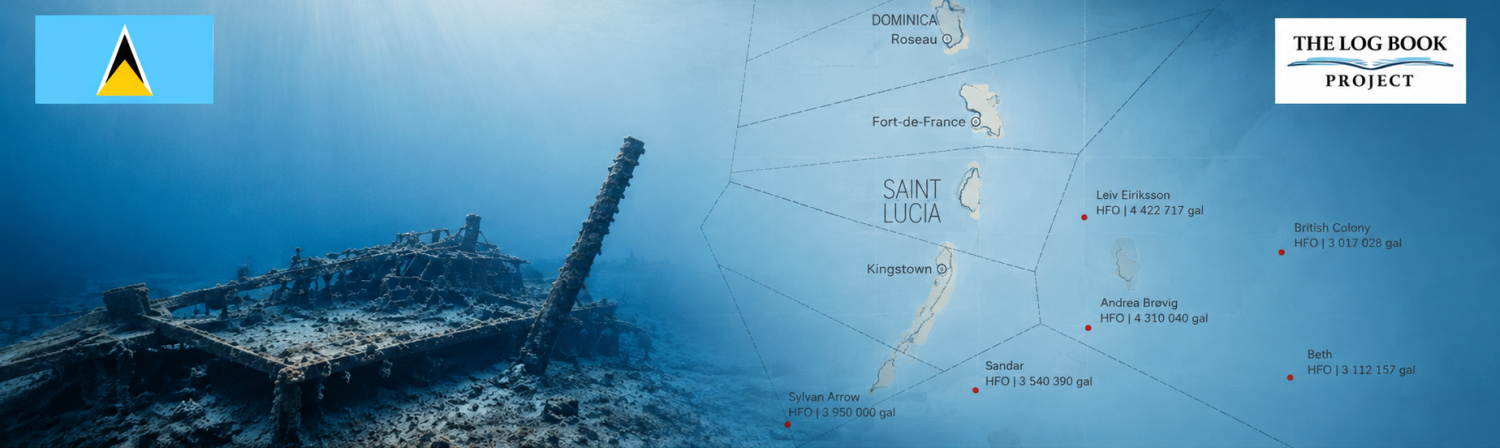
We primarily examine World War II shipwrecks in the Caribbean
Methodology
World War II left a significant and largely overlooked maritime legacy in the Caribbean. Several hundreds of wartime shipwrecks — many of them oil tankers or fuel-laden vessels — remain on the seabed, possibly housing millions of gallons of petroleum products and other hazardous materials. As these steel hulls continue to deteriorate, their presence raises questions that extend beyond history alone.
Despite the scale of this legacy, there has been no consolidated, region-wide effort to document these losses in a structured and accessible way. The Potentially Polluting Wrecks of the Caribbean project was developed to address this gap through careful, evidence-based research.
Purpose of the Project
The project aims to identify and document Caribbean based ship losses, primarily originating from World War II action, to support an informed understanding and further evaluation of the associated risks posed by this legacy.
The project does not assess operational risk but rather seeks to support Governmental led intervention by providing documented and contextualized historical information.
Our Approach
Our work is guided by research-led and evidence-driven methodologies, combining historical investigation and innovative compelling data graphics.
Research and Sources
Archival material, wartime records, shipping registers, and other cited historical sources. Incomplete or conflicting information — a common feature of wartime reporting — is explicitly stated. Estimates and assumptions are transparently labelled and presented based on most recent information available.
In doing so, the project aims to link historical research with present-day awareness, while remaining grounded in evidence and transparency.
Specifically, the project seeks to:
- Compile structured historical records for individual wrecks, including vessel type, cargo, and circumstances of loss
- Map and contextualise these wrecks to better understand regional patterns and legacy
- Support historical, environmental, and heritage discussion by making evidence transparent and accessible
- Provide a foundation upon which further research or assessment may be undertaken
The project does not assess operational risk or recommend intervention. Its role is to document and contextualise historical information responsibly.
Our Approach
This work is guided by a research-led and evidence-driven approach, combining historical investigation with careful presentation.

Research and Sources
Archival material, wartime records, shipping registers, and other historical sources are examined critically. Where information is incomplete or conflicting — a common feature of wartime reporting — this uncertainty is made explicit rather than resolved by assumption.
Documentation and Mapping
Information for each vessel is organised into structured records and spatially represented to support interpretation and comparison. Mapping is used to illustrate historical context and regional patterns, not to provide precise wreck locations or navigational guidance.


Collaboration and Alignment
The project aligns with wider international efforts addressing potentially polluting wrecks, including initiatives such as the Malta Manifesto and Project Tangaroa. This collaboration helps ensure that Caribbean data and perspectives form part of broader global discussions.
What Is Considered a Potentially Polluting Wreck
Within this project, the term Potentially Polluting Wreck refers to a vessel whose cargo, bunkers, or onboard materials may still be environmentally relevant due to their persistence within a deteriorating hull.
A fuller explanation of the term and its wider context is provided here:
What are Potentially Polluting Wrecks (PPWs)?
Classification within this project reflects potential relevance based on historical evidence, not confirmed pollution or assessed threat.
Why This Work Matters
The wrecks documented through this project represent both a historical record of wartime loss and a long-term material legacy beneath Caribbean waters. By bringing together dispersed and often fragmentary information, the project contributes to a clearer understanding of this legacy and supports responsible discussion about its significance.
In doing so, the project aims to link historical research with present-day awareness, while remaining grounded in evidence, transparency, and respect for uncertainty.